Post Top Ad

Post Top Ad

Wednesday, January 6, 2010

11:49 AM

Witkar: The First One Way EV Carsharing System


Speaking with Eric Britton of World Streets today, I was reminded that the first one way electric vehicle shared car system goes back way before Praxitele, to Witkar in Amsterdam in the late 1970s and early 1980s. Watch the short video and I think you will be amazed to see all the elements of modern carsharing - a very clever (but crude) docking and recharging system, card access and computer control of vehicle access with the member entering their PIN number with a dial phone!) Rates were reasonable: 3.5¢ (equivalent USD) per minute but the low speed EVs had only a 6 km range and slow recharging time.
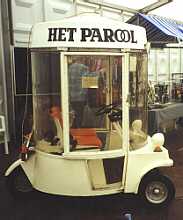
Hopes were high that the system of 20 stations and 35 Witkaren would offset 10% of trips in the inner city.
Eric wrote a nice piece about it in Wikipedia so I'll let him do the talking:

The Witkar (Dutch, literally "white car") is one of the first technology-based carsharing projects in the world. It is the invention of Dutch social inventor and politician Luud Schimmelpennink, an industrial designer and at the time Amsterdam city councilor.

The first actual Witkar project took place in Amsterdam between 1974 and 1986. While it provided daily service for more than four thousand registered users over those years the project never got beyond the limited demonstration phase due to a lack of support by government.

The system was initially conceived in 1969 by Schimmelpennink in order to reduce traffic in central Amsterdam, but it failed to win the support of the City Council and was spun off to be developed by a specially formed co-operative society. The co-operative managed to raise loans of US$ 250,000 for the first phase though 1974. This included the design and construction of the vehicles, the purchase of a PDP-11 mini-computer for the central control system, development of the control software, and construction of the first 35 cars and five stations. A further 10 stations were scheduled for operation by the end of 1976, by which time the fleet should be extended to 100 vehicles. The ultimate target was 150 stations and 1000 vehicles, but as a result of lack of government support this never happened.

The core of the Witkar concept is that of people sharing small environmentally acceptable vehicles specially designed for urban use. It was seen by Schimmelpennink and his team as a way to wean people away form conventional cars ownership and use, on the grounds that such vehicles have no place in densely settled cities.

These were specially designed electric vehicles. They had two seats, and offered little luxury. They were very easy to recognize. The vehicles were located around the city in pods. In Amsterdam 35 of these cars were available to hire from 5 stations in the city centre. The original system was designed for fully automatic control, including direct debit of hirers' accounts at the Amsterdam Savings Bank.

The idea was that any person could take a Witkar, and leave it at the Witkar station closest to his destination. The initiators thought that the flow of traffic to and from these stations would allow for an even spread of Witkarren (the Dutch plural of Witkar) . The system actually operated. The problems were several: the vehicles needed long recharging times, so many were needed to have some on the road all the time. The biggest problem was that the flow of traffic was generally in one direction. As a result of this, some stations were always full, and others always empty. To correct this by moving Witkarren would have caused a lot of extra traffic.

As of this date (January 2007), Schimmelpennink and his associates are planning a new Witkar program for Amsterdam, where he has recently been re-elected to the Municipal Council.


This photo is a rendering of the Schimmelpenink's updated Witkar concept. Additional information about the orignal project can be found Quip van Winkel's . . Witkar posting,

Tuesday, December 15, 2009

5:51 PM

TRB Carsharing Sessions 2010

It's that time again - the annual meeting of the Transportation Research Board in Washington DC will happen January 10-14.

Two sessions include presentations specifically about carsharing, both on the afternoon of Monday, January 11th.
• Carsharing and Bikesharing: Evaluating Market Share and Modal Impacts 1:30PM- 3:15PM
• Parking Policies and Approaches: Public Transit and Carsharing Hilton 3:45PM- 5:30PM

They're both happening at the Hilton Hotel near Dupont Circle. The sessions are sponsored by the AP020 Emerging and Innovative Public Transport and Technologies subcomittee, chaired by Dr. Matt Barth of the University of California at Riverside. The subcommittee meeting will be held at noon on January 13 at the hotel.

The first carsharing session at the main TRB conference includes presentations about both carsharing and bikesharing, and evaluates the market demand and impacts of these innovative modal options in Canada, the United States, and worldwide. The presentations include (click on links below for a longer description of the session):

Carsharing’s Impact on Household Vehicle Holdings: Results from North American Shared-Use Vehicle Survey (10-3437**)
Martin, Elliot - University of California, Berkeley
Shaheen, Susan A. - University of California, Berkeley
Lidicker, Jeffrey R. - University of California, Berkeley
Carsharing: Analyzing Interaction Between Neighborhood Features and Market Share (10-1304)
Grasset, Vincent - Ecole Polytechnique de Montreal, Canada
Morency, Catherine - Ecole Polytechnique de Montreal, Canada
Bikesharing in Europe, The Americas, and Asia: Past, Present, and Future (10-3567)
Shaheen, Susan A. - University of California, Berkeley
Guzman, Stacey - University of California, Berkeley
Zhang, Angela Hua - University of California, Berkeley
Defining a Primary Market Area and Estimating Demand for Large-Scale Bicycle Sharing Program in Philadelphia (10-0717)
Krykewycz, Gregory R. - Delaware Valley Regional Planning Commission
Puchalsky, Christopher Martin - Delaware Valley Regional Planning Commission
Rocks, Joshua - Delaware Valley Regional Planning Commission
Bonnette, Brittany - Bonnette Consulting, LLC
Jaskiewicz, Frank - JzTI

The second session deals with parking, since it is one of the major factors influencing choice of transprotation mode choice.
Carsharing Parking Policy: Review of North American Practices and San Francisco Bay Area Case Study (10-2921)
Shaheen, Susan A. - University of California, Berkeley
Cohen, Adam - University of California, Berkeley
Martin, Elliot - University of California, Berkeley
Carsharing and Reduced Vehicle Ownership: Making the Connection in Residential Parking Requirements (10-0232)
Engel-Yan, Joshua - Metrolinx, Canada
Passmore, Dylan - IBI Group, Canada

Two other papers about parking are scheduled for presentation but don't specifically include carsharing:
Minimum Parking Requirements, Transit Proximity, and Development in New York City (10-1644) and Station Area Planning and Parking Management in the Urban Core: Cases in Oakland and Berkeley (10-3279).

These papers, along with all the others that passed TRB review process are included on a CD included with registration or available for purchase.

Friday, November 27, 2009

12:53 PM

Next Big Thing, part 1: Car2Go in Austin

In what seems like an unlikely place to launch a new mobility service, Daimler AG chose Austin, Texas, as the site for initial foray into North America. I say unlikely because, as urban and green and uncharacteristic of Texas as Austin is, it's got a long way to go before it matches the land use patterns and car-lite development of other "classic" carsharing cities.

And launch they have: 200 vehicles all over the downtown area. (Full disclosure: through my association with Team Red mobility network, I consulted with car2Go during the early days of the Austin project.)

When I asked them about this, Daimler officials half jokingly replied that if they can make it work in Austin it can work anywhere. And they're probably right, too. Because Car2Go is really quite different from other carsharing services. It has taken me a long time to wrap my head around the mobility and transportation implications of the Car2Go service model.

What is the "next big thing" about Car2Go? Basically, this:

- On demand usage - no need to have to make a reservation and specify a return time
- One way trips - pay by the minute
- Floating parking - greater flexibility in cities with parking congestion

Car2Go Austin rates are 35¢ per minute - perfect for one-way trips - and are discounted for longer uses: $12.99 an hour or $65.99 for a full day. That means if your trip is longer than 37 minutes the hourly rate kicks in or trips longer 5 hour the daily rate kicks in. Vehicles are geo-fenced and cannot be taken more than 200 miles from Austin.

I'm assuming that the majority of trips are likely to be spontaneous but the system does allows members to reserve vehicles up to 24 hours or as little as 15 minutes in advance. They do not allow more than 5 reservations in a 24 hour period and they must be separated by at least 30 minutes. A vehicle cannot be rented for more than 30 days. Reservations can be cancelled as little as 15 minutes before the trip start without charge.

As with other carsharing companies, car2go maintenance staff will clean vehicles but unlike traditional carsharing, the staff will also refuel vehicles as needed. Fuel cards are provided for a member on a long trip to refuel the vehicle and, as with other carshares, member are not supposed to return a vehicle with less 1/4 tank. If they do refuel, 10 minutes deducted from the trip time.

As with Hertz Conect, car2go only provides state minimum liability insurance assuming that most users will have their own personal auto insurance coverage. This is something I have ranted against in past postings as it undercuts the attractiveness of using the service as an alternative to car ownership. Having said that, I think it illustrates the different concept that Daimler has in mind for car2go.

Take a moment (actually 4 minutes) and watch the way car2go describes itself:


Personal Public Transport

Where car2go seems to be headed is not as another more fully featured, more convenient carsharing service, which it certainly is (albeit with a highly specialized class of vehicles), but something different. This phrase - "personal public transport" (from the video above) perfectly describes what they have in mind. Car2go is not focusing on serving the car-less households of America - it's providing "public" transportation for everyone - a much bigger market. Regarding the Autolib project in Paris, many people have observed that the one-way trip option does compete with public transportation (more precisely "collective transport") but I'm now not sure whether it's a bad thing or not.

First Velib, then the Bixi people in Montreal have demonstrated a notion that an individual transportation mode (a bicycle) can be "public" as well - not only because it's government sponsored or sanctioned, but also because the mode helps meet other social and environmental goals. So why shouldn't it be worthy of public support? The fact that we're talking about cars rather than bicycles with car2go or Autolib changes the equation but perhaps not as much as I had earlier assumed. One argument might be context: if a location has limited transportation alternatives, would a fleet of Smart cars making a whole bunch of 1 way trips be any worse than 1/4 full buses or a bunch of taxicabs, as in New York City?

Austin and Ulm

The City of Austin is to be commended for staying with the project, even during time of budget problems, the city stayed with the project. The use of a car2go vehicle includes free parking at meters and city-owned garages. Car2go is paying a usage fee to the City of Austin in the form of free driving minutes for employees driving on City business.

Austin has partnered with Car2Go with an arrangement that allows free use by city workers on business in return for designating 40 reserved parking spaces around downtown and 85 spaces in municipal garages and parking lots. The rest will be (in the words of the Austin Statesman) "free-range Smart cars", as long as the trip ends within a "geo-fence" roughly bounded by 51st Street, MoPac Boulevard (Loop 1), Oltorf Street and Interstate 35. Of course, traditional carsharing round trips may extend outside that area.

There are some interesting differences and similarities between Ulm and Austin:

Ulm - 120,000 people living in 119 sq. km. = 1,023 people per square kilometer
Austin - 750,000 people living in 767 sq. km = 1,252 square kilometer

But Ulm has excellent transportation network and supportive land use patterns and Austin, with its good, by American standards (but arguably under-appreciated) public transport system including a new light rail line), is still an auto-oriented city, except for a few areas downtown and around the University of Texas.

So now that Ulm has been operational for a year, what is Daimler learning? After a little over a year 15,000 of the city's 80,000 driving age residents are members of Car2Go, according to Nicholas Cole, Car2Go North America, president. The Daimler press release has other interesting numbers from Ulm:

The 200 smarts of the first pilot are rented 500 to 1,000 times per day and they are used by 15,000 customers which equals more than 15 percent of the citizens who possess a driver’s license in Ulm. 90 percent of the participants take advantage of the unique offer to use car2go spontaneously without booking in advance and for one-way trips.

The goal of the Austin pilot project is to gather experience we can use to ensure the public launch of car2go in North America in 2010 is successful," says Nicholas Cole, CEO of car2go North America LLC. "In the second phase we will increase the number of cars in Austin and open the service to the public. We are also talking to a large number of cities in North America and Europe about additional rollouts of car2go."

Hmmmmmm...

PS: Although there isn't an iPhone app for the Car2Go in Austin, yet (it's on the way, I'm told), die hard US iPhone enthusiasts will want to keep close tabs on the Ulm Car2Go fleet by downloading the app Go2Car (free). It shows the current location of the vehicle, whether it's in use or not and the fuel level.

Sunday, October 25, 2009

1:55 PM

Is Our Love Affair With Cars Cooling?

A recent article entitled "Rebel without a car" that appeared in the Los Angeles Times Business section on Oct. 9, 2009 indicates that a shift in attitudes is beginning to happen in the USA, at least among the younger generation.

The article, reported by Martin Zimmerman, cites a J.D. Power and Associates market research report that:

"Online discussions by teens indicate shifts in perceptions regarding the necessity of and desire to own cars." Part of the reason, the article says is that during the current recession "the cost of owning a car probably makes less sense than it did when gas was 30¢ per gallon..." The report suggests that, "with the advent of social media and other forms of electronic communities, teens perceive less of a need to physically congregate and less of a need for a mode of transportation."

The analysis focused on teens, ages 12-18, and "early careerists", ages 22-29. The change in was identified from monitoring hundreds of thousands of auto-related websites, blogs, and social networks such as Twitter and Facebook.

The comments about the article on the LA Times blogsite were also interesting.

Sunday, October 11, 2009

3:44 PM

Multi-Mobility in the Los Angeles Basin - Some thoughts about Carsharing and Bicycles


Carsharing was one topics up for consideration at the second Multi-Mobility Forum sponsored by the Los Angeles County Metropolitan Transportation Authority on October 8. The driving force is the SB 375 passed by the California legislature last year mandating substantial cuts in greenhouse gases from transportation by 2020. Attending were representatives from many of the cities in the LA region.

Some people attending remembered the "glory days" of carsharing in Los Angeles region when Flexcar had more than 250 vehicles that were finally starting to generate revenues. They wondered what it would take to attract a major carsharing operator like Zipcar or Hertz Connect back again.

Technically, carsharing never completely left the area. Even before the merger with Zipcar, Flexcar had scaled-back the LA fleet (as they did in other markets, as well) and Zipcar continues to provide about 20 carsharing vehicles at the UCLA and USC campuses and immediately adjacent areas.

In my short presentation I reminded everyone that carsharing isn't a transportation demand management strategy by itself (like transit, ridesharing or bicycling), but it's the "glue" that can increase participation in these programs since it provides an alternative to car ownership (or second car ownership). And, as we all know (from personal experience):

Car ownership = Car over-use

Several of the presentations were about bicycle programs, including an interesting program to encourage people to buy folding bicycles for use on transit (see photo at the top of this post). I was personally fascinated by the folding bicycle demonstrated by Big Fish at the forum and also pleased to see the Bike Station was developing a modular approach to provide services through its new incarnation as Mobis.

I think public bicycles have some important lessons for carsharing. Most importantly, the lesson from the Paris Velib system, is to Think Big. Only by thinking big (and doing big) can you attract the kind of public attention that can make a difference. In addition, in my presentation I offered some suggestions for working with carsharing companies. I've posted several of the slides from presentation at the end of this post.

Unfortunately, unable to attend this session was Dan Sturges of Intrago Mobility, who coined the phrase multi-mobility and has one of the clearest visions of what the future of personal transportation could look like. His vision includes a combination of small electric and pedal vehicle for short trips ("near car") and strategically-located carsharing vehicles in clusters near major hubs for longer trips ("far cars"). His company is putting together the system that will make all this possible.


Several cities in the LA area are ripe for large-scale "classic" neighborhood carsharing (again): Long Beach and Santa Monica, in particular and I wish them well. Many thanks to Fred Silver of Calstart and Robin Blair of LA Metro for hosting the event.

Friday, October 9, 2009

2:28 PM

CommunAuto - North America's Oldest Auto Partage is 15 Years Old

I was reminded recently how easy it is to lose sight that a lot of what happens in North America happens in Canada. Oh, ya, those guys up there.

Communauto has been growing for 15 years - 5 years longer than any of us Gringos "south of the border". It was founded by Benoît Robert and his collaborators in 1994. Now Communauto serves over 20 000 members, has a fleet over 1000 self-serve vehicles, divided throughout 310 parking stations in the greater regions of Quebec City, Montreal, Sherbrooke and Gatineau.

CommunAuto has always done things its own way: started as a school project in 1994, it was a nonprofit with 6 vehicles - 4 Pontiac Fireflies and 2 Ford Festivas. In 1997 Benoit took the company private merging operations in Quebec City and Montreal. (Here's a link to an English translation of his the original market research and a short history of the company in French.) It has unique rate plans not copied from anyone - charging the highest monthly fees and lowest per hour rates of any carshare, anywhere - as low as $1.60 per hour on Monday, Tuesday, Wednesday.

And CommunAuto has traditional kept its vehicles in service much longer than other carshares, up to 5 years at one point, giving them much better cost structure.

Something else CommunAuto has done that very few others have is a detailed analysis of greenhouse gas reduction from their operations. Completed in February 2007, the consulting firm of Tecsult estimates that as a result of carsharing each CommunAuto member has reduced their CO2 production by 1.2 tons per year. Tecsult estimates that if the market potential of carsharing was attained, this service alone would lead to a reduction of CO2 emissions equivalent to 5.6 times the reduction targeted for alternative modes of transportation by the 2006-2012 Action Plan – Quebec, all without any costs for the taxpayer. These numbers reflect the fact that almost 90% of CommunAuto member households are car free, much higher that 30-40% typical in the US.

To jump start the 15th anniversary, Communauto organized a photo event on September 5th to make the short film (above) demonstrating the advantages of car sharing in our cities. In October close to 150 people attended a celebration hosted at Montreal’s City Hall with partners, elected representatives and long-lasting users of Communauto’s services revisited the company’s most memorable moments.

Beyond being a role model for many car sharing organizations in North America, Communauto participated in developing a code of ethics subscribed to by many carsharing organizations. On the operation front they have developed partnerships with public transit and taxi companies and, put a lot of effort into integrating Smart electric vehicles in its car fleet, including a recent partnership with Veolia and an earlier project Branché around 2000). Below is a chart of their growth up to 10,000 members.

Bon anniversaire, CommunAuto!

Saturday, August 1, 2009

1:48 PM

Hertz Connect Rolling Out New Cities


The new carshare on the street, Connect By Hertz, is showing it means business. After the initial launch in Manhattan, London and Paris, Connect spent some time getting their feet on the ground. But they were busy in the spring and by this summer Connect had expanded their New York fleet to over 400 hundred vehicles - competing in Zipcar's sweetest neighborhoods all over Manhattan. The growth was facilitated by their partnership with Icon Parking, Connect now has locations from the tip of Manhattan up to East and West 90th Streets. In comparison Zip has over 2000 vehicles in several boroughs and adjacent New Jersey communities).

A recent check of the Hertz Connect web site now lists Boston, Chicago, Washington DC and San Francisco, each with one location with several vehicles. In Chicago, for example, the downtown Loop location has 4 vehicles - 2 Priuses, a Ford Escape SUV and a Camry. (The Washington DC location is at Marriot hotel corporate headquarters and could be laying the groundwork for a very interesting partnership.) Oddly Denver isn't one of the cities listed, although the Spire condo project there indicates they'll be offering residents Connect services. That would make Denver the city with the most carsharing services right now - E-Go (Boulder Carshare), Occasional Car (a recent start up with 2 vehicles) and Hertz Connect.

And Connect has added a couple of college/university campuses to its list - having taken them away from Zipcar. These are naturals for Connect since Hertz likely has a branch in the town so adding carsharing is a piece of cake.

But exactly how they're achieving this growth is a bit of a mystery - since they don't seem to be using any of the traditional marketing approaches - transit advertising, media trade outs, etc. They have done some interesting awareness campaigns using Go Gorilla Media including sidewalk logo projections, sidewalk stenciling (is that legal?) and fake "lost dog" signs (the tear offs give the Hertz Connect web site).
Hertz Connect is going after a somewhat different customer demographic - offering more vehicles on the upscale end. In addition to a Mini or a Prius at just about every location, and the usual assortment of Mazda 3s and Toyota Yaris, there are many Camrys and some locations have Volvo C70s and even a Mercedes GLK 350!

Hertz Connect is being helped in NYC by Zipcar's on-going problems with customer service. The Zipcar call center can be infuriating (I know from experience) and fleet maintenance in NYC (and other cities) apparently leaves a LOT to be desired - read a bunch of uphappy Zipcar members complaining (and very few members complimenting) on Yelp.

The London and Paris operations of Connect remain mysteries with only minor expansions of the fleet. But perhaps that's not surprising because Zipcar has been having trouble figuring out the UK market and they've been in London and LOT longer than Hertz Connect. And speaking of mysteries, Mint in New York, is another mystery - very little action since their launch.

And while I'm on the subject of car rental companies operating carsharing, it's worth nothing that U-Carshare by U-Haul has been quietly adding additional cities and a couple of schools, as well. That said, the U-Carshare marketing strategy is also a mystery - almost invisible in my home town of Portland, Oregon (although they finally had a presence at the recent Sunday Parkways event I wrote about earlier).

It's shaping up to be an interesting year in carsharing.